
Labour
Monitoring Tool
Reimagination of the WHO partograph used to track medical vitals and determine early complications during maternal labour.

Role
UX Research
UX Design
Product management
Client
Bill and Melinda Gates Foundation
Team
Kanika(Me)
Sanika Sahasrabuddhe
Dinesh Borana
Divya Dutta
Duration
10 months

What We Did
Elimination of graph makes it 700% more likely to use the tool.
Instructions to fill vitals are 250% easier than the previous tool.
New labour monitoring tool requires 75% less training time.
The Challenge
The labour monitoring tool prescribed by WHO is a paper based graph tool to track medical vitals during maternal labour designed for the auxiliary nurse midwives or ANMs. The ANMs, auxiliary nurse midwives of Bihar who plays a vital role in labour monitoring process were unable to comprehend the graph which had disabled them to effectively use the partograph. The graph is a very critical part of the Partograph in determining complications of the delivery and hence needs to be comprehensible by ANMs.
How we did
Introduction to the User

.
ANMs are primary users of the partograph also they have a responsibility in dispensing public healthcare. These nurses are a female health worker in India who communicates best practices between the community and the health services. with the responsibility of creating awareness she also attends the patients(expecting mothers) during their labour. And therefore Partograph was introduced to equip her to analyze and take necessary actions during labour to record data for managing labour thereby saving lives.
ANMs Journey
Mapping the pain-points in ANMs journey during maternal labour and labour monitoring.


The Solution
Reimagining the Labour Monitoring Tool
With the goal to mitigate the mortality rate among the women and children where the emphasis was towards improving the infrastructure of primary healthcare centers and allocate better healthcare services in rural Bihar. We joined hands with the Government of India where our role included understanding the implication and implementation of schemes that incentivize institutional deliveries. Our role was to design labour monitoring tool also known as Partograph, that enhances preliminary and critical level care during labour monitoring.

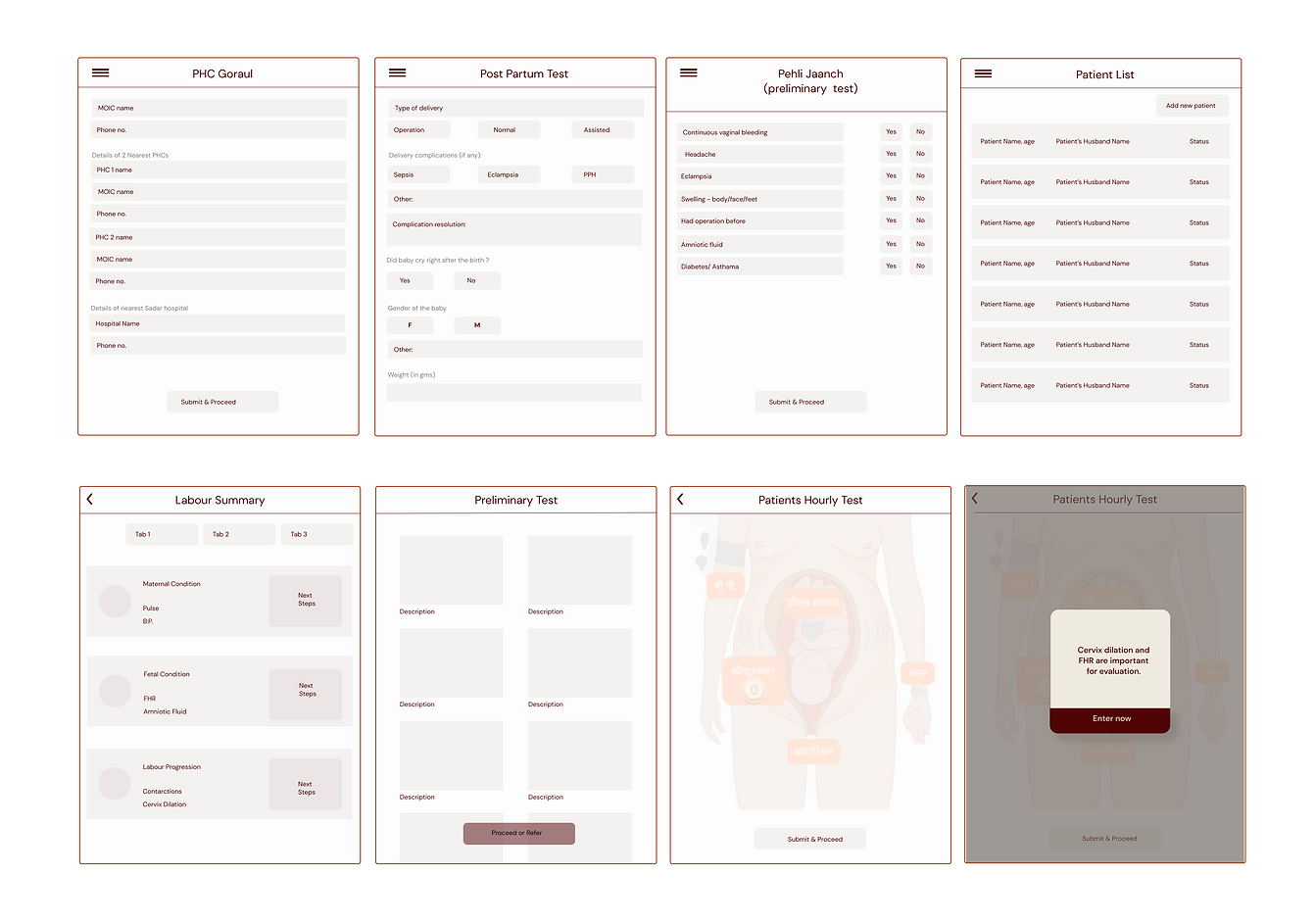
The new Labour Monitoring Tool(Partograph), makes it easier for ANMs(user) to fill and track vitals with prompt analysis of (each+combination) vitals using the simple visual language of colors and human anatomy.
An android based app was designed for a tablet to be mounted in every primary healthcare center.

Detecting early stage complications- Pehli Jaanch
Using a combination of illustrations and local language/words for ANMs to understand and communicate efficiently.
Tracking Vitals
Usage of visual representations like human anatomy and cues(red/orange, green) to reduce cognitive load and focus more on the delivery of a child rather than determining the outcome of vitals.
Timely feedback and notifications
Providing timely feedback and notifying users to enter all the required data for accurate results.
One-stop Labour Monitoring Tool
Reducing paperwork to maintain documentation of patient records which helps in prioritizing the other important tasks like a referral and labour.
WHY We Did
Insights driving design decisions
Qualitative Methods like Focus groups, user interviews, and ethnography studies were conducted which led to a deeper understanding of the ecosystem, product(partograph a.k.a labour monitoring tool) and the user. Also, uncovering the interaction and usability of currently placed infrastructure.


Iterations and Testing
Throughout the course of the entire design process, we regularly tested the paper-based concepts, visual language for the digital tool, hardware to be integrated with the tablet. Testing was an ongoing process parallel to the design and development which helped us in determining the acceptance of the tool among ANMs and interaction challenges.

Intermediate Testing with anm
Testing Site: Primary Healthcare Centre Maner, Bihar
Interviewers: Kanika Choukse (Myself) & Dinesh Borana
Intermediate Testing Results which helped us in enhancing designs.


Workflow
As I managed both the design and development team I was also engaged in designing the algorithm used in the newly designed partograph.
Workflow for the app was designed based on the recommendations and validation from experts - doctors, nurses and ANMs. Vital thresholds and alerts were placed and designed based on the WHO recommendations similar to the existing partograph guidelines.
Including the workflow, we also designed the information architecture for the digital tool, visual designs, and branding guidelines for the development team.

Takeaways
Effective collaboration- Labour monitoring has been a critical area of improvement and to design intervention. I collaborated with other organizations like Dimagi to work on this challenge by sharing knowledge where I organized and moderated co-working sessions.
Leadership- Soon after I joined the project I was offered with an opportunity to lead the team of 2 visual designers and 1 engineering intern. I learned to prioritize my work as a manager and UX designer for the team and also to strategize the workload based on the strengths of the team members.

" She managed the project that she is currently working upon without any formal notice or instruction from anybody. Kanika has been mannerly and polite. I have found her to be hard working and methodical. She has consistently demonstrated an ability to rise to any challenge that she must face. "
- Priyanka Dubey
Senior Researcher

" During the work Kanika took care of the Project as designer and Project Manager. She was always concerned with the visual balance and the interaction of the users of the project. She helped me to the integrate and create good design."
- Dinesh Borana
Visual Design Intern, currently UX Designer at IBM